
Voice of Ukraine in Japan: How Poetry Keeps Hope Alive During War
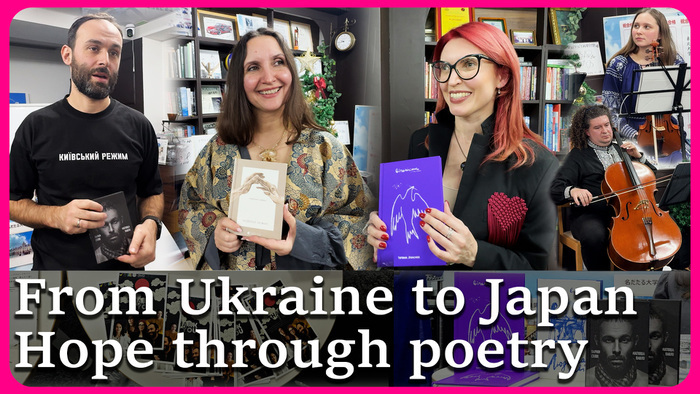
"Voices from Ukraine": Ukrainian Poets Come to Japan for the 'First-Ever' Ukrainian Literature Festival in Japan
In Shibuya, Tokyo, there is a Ukrainian support center called Himawari. Here, on the 8th floor, is one of the two public Ukrainian mini-libraries in Tokyo, which is also part of the Ukrainian book club “Literary Evenings in Tokyo.”
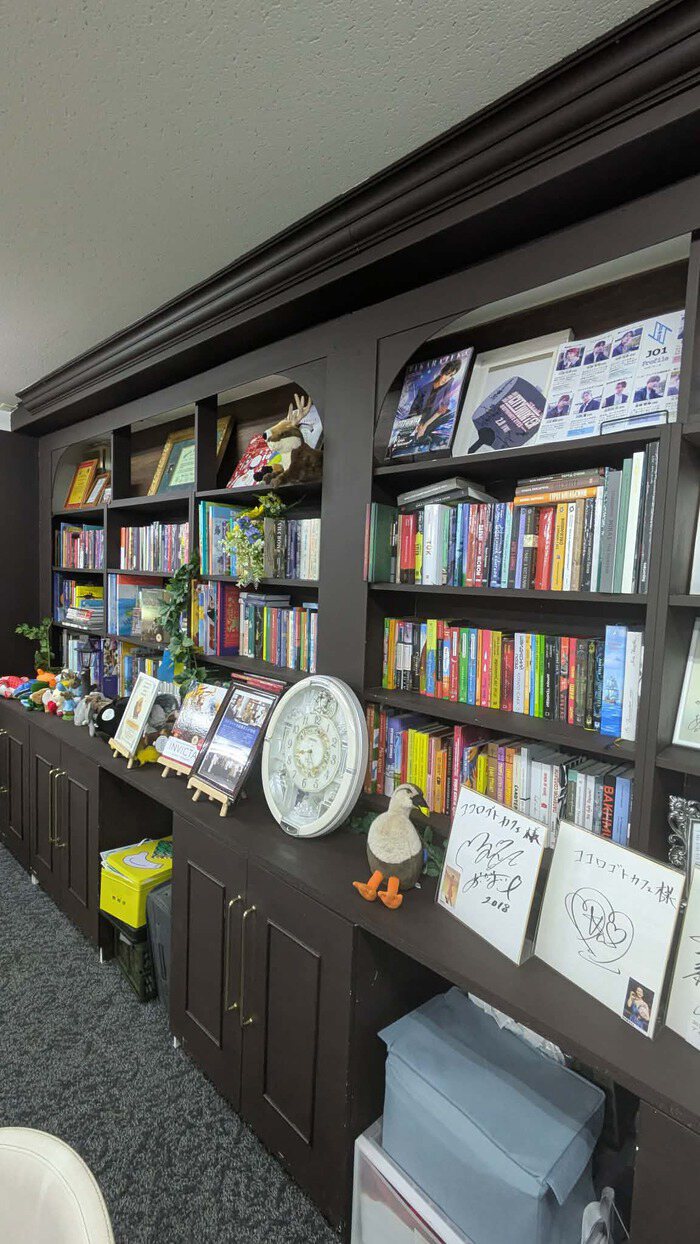
(Photo : Ukrainian mini-library in Ukrainian support center Himawari in Shibuya, Tokyo)
A special three-day event took place in this small library from December 12 to 14 of 2025 ー the Ukrainian literature festival called “Voices from Ukraine.” It was a special occasion for the Ukrainian diaspora in Japan, bringing together novelists, poets, translators, readers, and even musicians. The first Ukrainian literature festival this size to take place in Japan, according to organizers.
I, Viktoriia Melnyk, was curious to cover this myself. I work as a staff member at NTV News in Japan, and I am Ukrainian. I moved to Japan after the war in Ukraine began and have been living here for three years.
On December 13, my Ukrainian colleague Roksoliana Halanyk and I attended one of the festival’s evening events — a musical and poetic performance by contemporary Ukrainian poets who had traveled all the way from Ukraine to Japan.
After attending the event, we decided that this story needed to be shared with the world.
How It Started: From the First Ukrainian Library to the First Literature Festival
All invited writers were able to attend the festival thanks to the efforts of two women: Dariia Murakami and Viktoriia Matiusha.
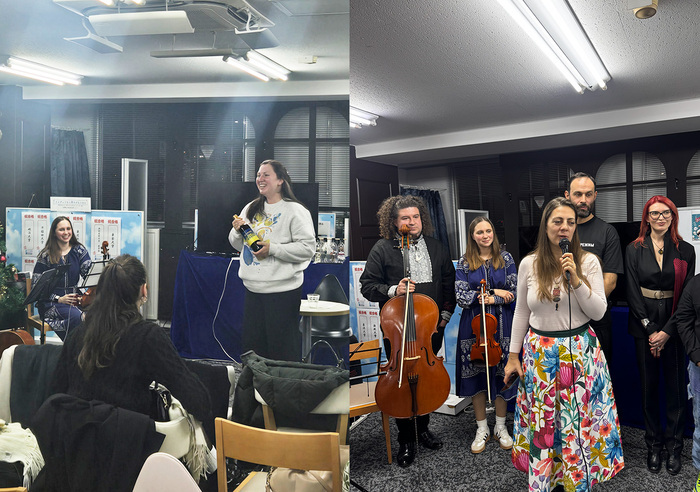
(Photo : Dariia Murakami (left) and Viktoriia Matiusha (right) at the musical and poetic performance on Dec. 13, 2025)
Daria has lived in Japan for many years and has actively supported Ukrainian refugees since the beginning of the war. Thanks to her efforts — and with the support of YMCA and EPAM — two Ukrainian libraries were opened in Tokyo in 2022.
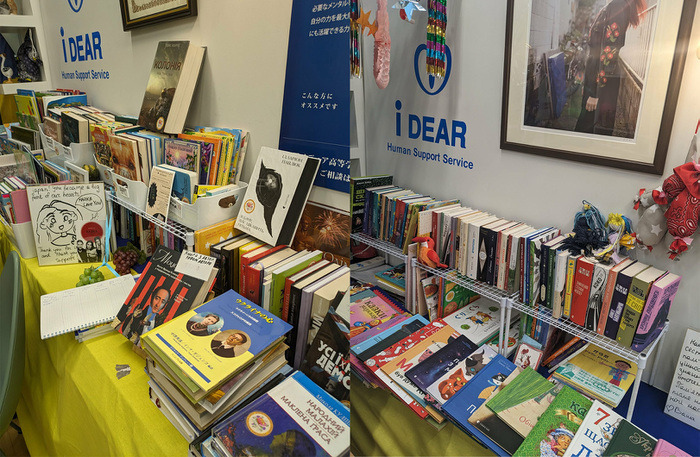
(Photo : Ukrainian mini-library in the Himawari support center in Shibuya when it first opened in 2022)
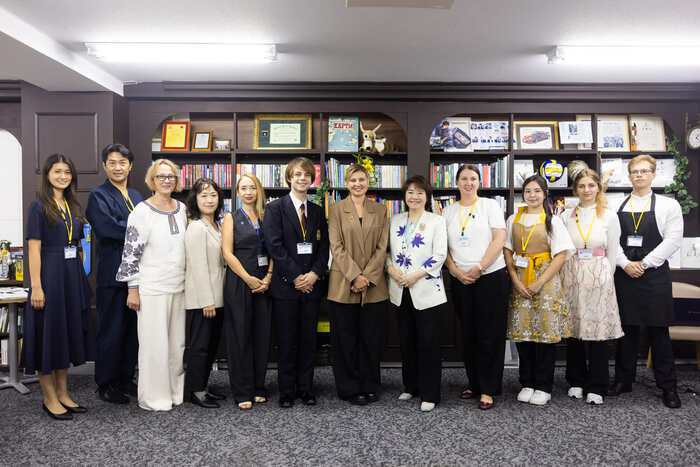
(Photo : First lady of Ukraine Olena Zelenska at the Himawari Ukrainian Support Center on Sept. 2, 2025, as part of her mental health initiative for Ukrainians “How Are You?”)
Daria says she had been thinking about organizing a literature festival for a long time. The idea took clearer shape while she was compiling a list of Ukrainian-to-Japanese literary translations. In 35 years of Ukraine’s independence, she was able to find only slightly more than 30 such works.
Literature, Daria believes, is the voice of a nation. As she worked through the list, she realized that the lack of Ukrainian literature translated into Japanese was a serious issue. Wanting to find a way to promote Ukrainian literature among Japanese audiences, she began to see a literature festival as one possible solution — a way to introduce Ukrainian literature both to Japanese readers and to the Ukrainian diaspora living in Japan, who could then carry these stories and voices further into Japanese society. For a long time, however, Daria was unable to find sponsors.
Everything changed after she received a small donation from a Tokyo-based company to support her library. With these funds in mind, Daria reached out to literary manager and executive director of the OVO Literary Agency, Viktoriia Matiusha, hoping to invite at least one Ukrainian writer to Japan.
Daria wanted Japanese audiences to understand that the war did not begin in 2022, but in 2014, with Russia’s annexation of Crimea. For this reason, she first considered inviting Tamara Goriha Zernia, whose novel Daughter (Dotsia) — which depicts the early stages of the war and the occupation of the Donetsk region — had been named BBC Book of the Year and translated into 15 European languages. Daria felt that this book, in particular, had strong potential to resonate with Japanese readers.
Together, Daria and Viktoriia developed a broader program, and Viktoriia applied for a grant from the International Renaissance Foundation. The grant was approved, making it possible not only to invite a single writer, but several — and ultimately to organize a full-fledged literature festival.
“We Are Responsible for the Freedom We Fight For”: Why Poets Came to Japan
In total, seven cultural figures from Ukraine took part in the festival:
Olena Herasymiuk — novelist, service member, and civic activist;
Tetiana Vlasova — poet and cultural manager;
Pavlo Matiusha — novelist and translator;
Mariana Savka — poet, publicist, and publisher;
Olena Hrabb — director of Magenta Books;
Tamara Goriha Zernia — novelist and translator;
Viktoriia Matiusha — literary manager and executive director of the OVO Literary Agency.
The central figures of the poetry evening on December 13 were three of them — Tetiana Vlasova, Mariana Savka, and Pavlo Matiusha.
Each brought a unique creative voice. In Pavlo’s case, this also included direct military experience — he served in the Armed Forces of Ukraine.
What motivated these writers to travel such a great distance and take part in the festival?
Mariana Savka shared her thoughts:
“Our freedom and independence are the most important things to us. Freedom always comes with responsibility. We are responsible for the freedom we fight for. Ukrainian artists have taken on the mission of speaking about Ukraine to the world. For decades — even centuries — our enemy not only tried to destroy us physically, but also attempted to erase Ukrainian culture as if it were an unnecessary page of history.”
She added:
“Wherever we go, we see people looking at us with respect and deep emotion, discovering something completely new.”
Tetiana Vlasova described the journey to Japan as a cultural bridge:
“When we were preparing to come to Japan, many people in the cultural sphere were genuinely happy for us. This truly feels like a bridge. Our voice can be heard all the way here.”
Life During War through Poetry and Music
During the poetry readings, the poets were accompanied by two musicians ー cellist Glib Tolmachov and violinist Oleksandra Horbulova. The music they performed was an improvisation based on works by Ukrainian composer and cellist Victor Rekalo, who in 2023 created a cycle titled “Seven Simple Dawns.” Each piece symbolizes a different "dawn" experienced during the war.
The musicians themselves were evacuated Ukrainians who have been living and working in Japan since the beginning of the full-scale invasion.
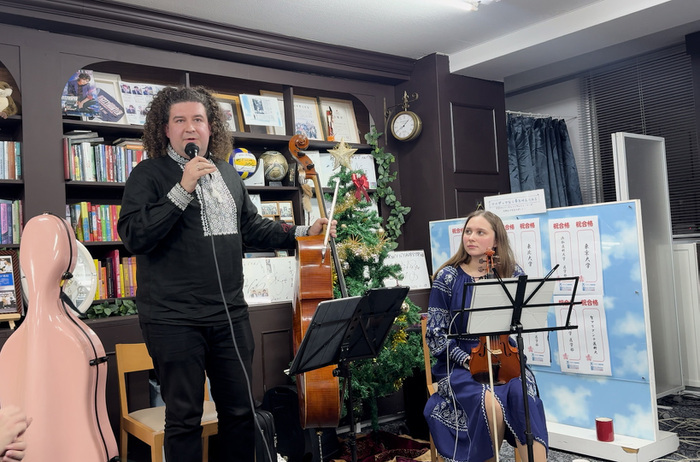
(Photo : Cellist Glib Tolmachov and violinist Oleksandra Horbulova who performed at the poetry reading on Dec. 13, 2025)
The evening was dedicated to the lives of Ukrainians during the war. The poets spoke about how the war has affected every aspect of daily life, yet has not broken them.
Tetiana Vlasova explained:
“Many people write about their military experiences. We have lots of service members who write, and that is extremely important right now. Veterans who fought, who for various reasons are no longer on the front lines, continue to write about the war.
I personally focus a lot on women’s experiences, which are also incredibly complex in this war. War has many dimensions. Through poetry, we show its ugliness — but also the strength it reveals within us.”
Poems to Share: Hope, Love, and Nostalgia
Poetry That Affirms Life: Tetiana Vlasova and Freedom
At the poetry reading event, Tetiana showcased her second poetry collection, Freedom (Vilnist), published in May 2025. Nearly all the poems were written after February 24, 2022. With this book, Tetiana toured Ukrainian cities that have been particularly affected by shelling.
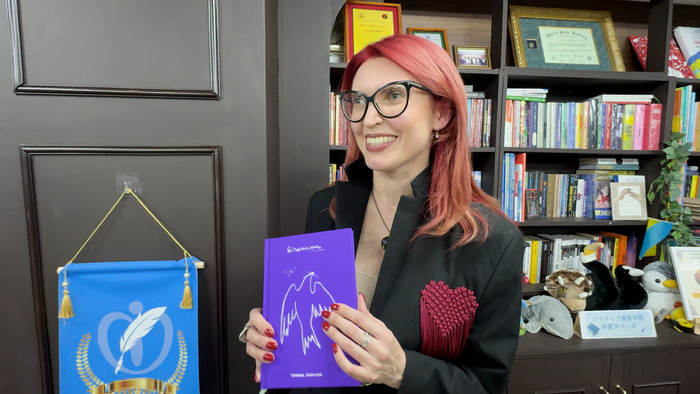
(Photo : Tetiana Vlasova with her book Freedom (Vilnist))
The book became both a chronicle of the present and a deeply personal wartime diary.
Tetiana mentioned that she was especially afraid of writing a sad book:
“ I didn’t want people to feel only sorrow or despair, so I tried to maintain a balance between darkness and light. The final poem (of Freedom) is exactly about this: even in times like these, people must continue to live, to love, and to create.”
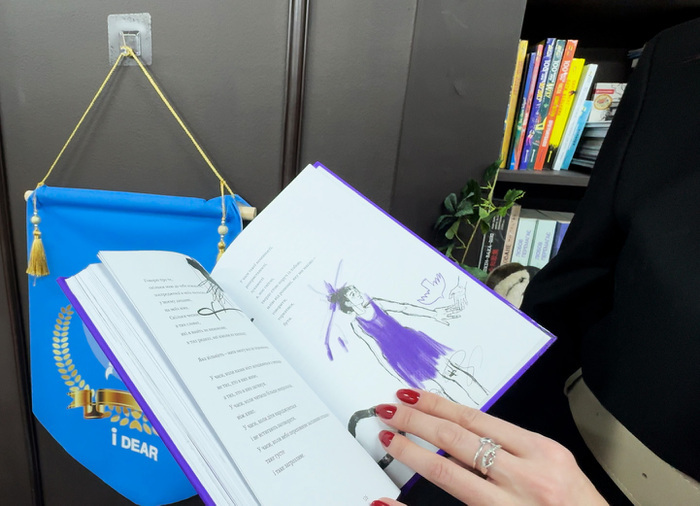
(Photo : Ilustrations inside Freedom )
During the evening, Tetiana performed several poems from this collection.
“Maria and I are sitting in her kitchen in the evening.
Maria’s lips look scorched, her eyes are swollen.
I’m drinking dry white wine,
Maria is drinking tea without sugar.
She says,
“The war, of course, is a real bitch.”
And that is, essentially, all Maria says out loud.
Her belly is wrapped like a snake
by a wide belt.
I have known Maria for a thousand years.
She does not live by conventions —
she simply got pregnant
already during the full-scale war.
And I ask her:
“Maria, aren’t you afraid at all?”
The world is different every day from the one before.
Souls, like glass, are shattered,
unable to heal.
Don’t you see what is really happening here? Death is not kind — yet damn it, now it is welcoming.Is this the kind of world you would wish for your child?Don’t you see how much pain surrounds us?Maria, you seem like a smart woman — what’s wrong with you? Maria blows on her cup, sighs:“You’re exaggerating. Let’s stop this conversation.Let’s go for a walk instead. Barefoot.We’ll look up at the sky and count who sees more stars.Let people think I am their prophet.Let them search for comfort or for rage;I will speak to them of salvation.People turn to prophets after every upheaval.I will not undo their losses.I will not give their lives back.But what if this world could be saved by my child?What if, beneath my heart, someone’s hope is growing?And I walk carrying it — to the envy of misfortune and evil.And this salvation is like a boat no force can restrain.In the end, history teaches us nothing but faith.In the end, what is harder — to give birth, or to be born?" Maria looks out the window — the sky beyond it grows lighter.Maria is beautiful, with a beauty almost wild, almost mad.Her belly is like a planet,moving — alive — breathing.”By Tetiana Vlasova
Tetiana noted that the aim was to show that Ukraine is not only a place of grief and sorrow, despite the immense pain the country continues to endure.
“I am always concerned that our performances should not create despair or hopelessness. I want them to be life-affirming. Our main message is that we speak about our country in a way that affirms life.”
Despite her desire to keep the performance life-affirming, emotion was unavoidable. While reading one of her poems, Tetiana became visibly overwhelmed and almost shed tears.
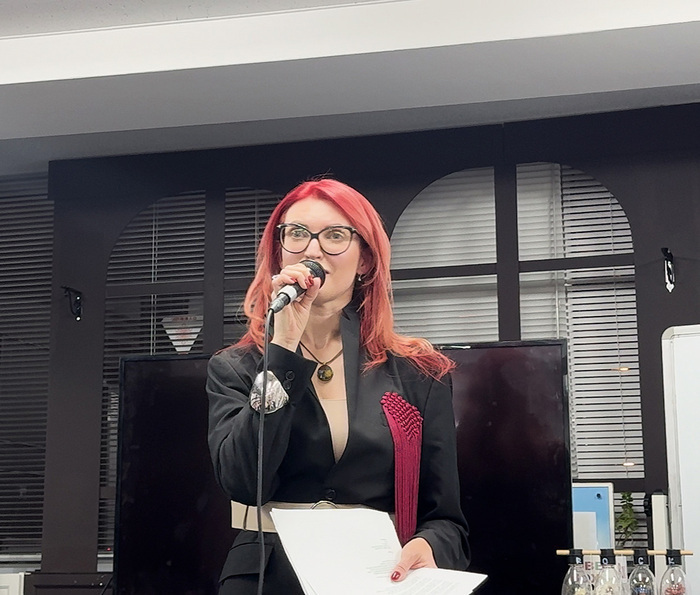
(Photo : Tetiana Vlasova reading poetry at the event)
“Rockets and bombs…
Not in movies — but here, beside us. Real.”
“While our cities rise again from the ashes,
I will not forget a single scream, a single gaze.
I will not forget a single day of that spring.
I will not forget a single day of this war.
February 24 happened yesterday.
And since that morning,
I remember everything.”
Forever Tender: How Strength Grows from Tenderness in Mariana Savka's Work
Mariana Savka featured her book Forever Tender, published in 2024. The poems span two difficult years — from August 2021 to August 2023 — and reflect resilience and the value of human life.
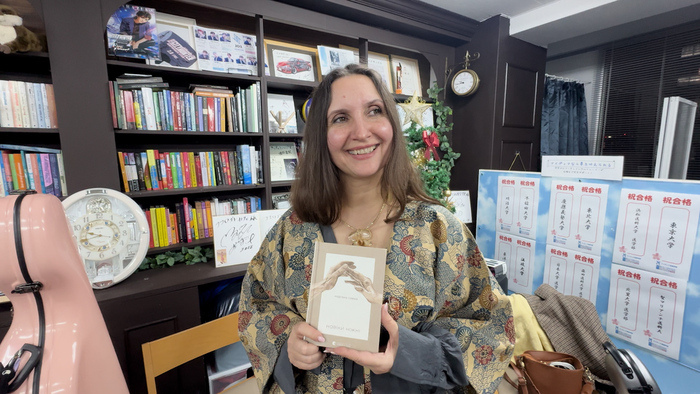
(Photo : Mariana Savka with her book Forever Tender)
Mariana noted that she believes her book resonates with Japanese culture in particular, as it is filled with both strength and tenderness. She explained:
“In my view, strength is not always obvious — it grows precisely from our tenderness and our capacity to love. Resilience is born from our determination to remain on this land. Forever Tender is about people who dare to survive in this world, amid the horrors unfolding around them.”
Some of her poems also reference cranes, which hold strong symbolic meaning in both Japanese and Ukrainian culture and poetry.
“The body, empty, without a bird, grows heavy like stone.
What does a person need a body for, if it cannot move?
Sometimes this happens — a person lives without wings,
yet inside them a crane is flying,
beating its wings against the soul.”
Although Mariana has never been a professional singer, she often incorporates singing into her performances, creating an intimate atmosphere and a deeper emotional connection with the audience. That day, she also performed several of her poems in song.
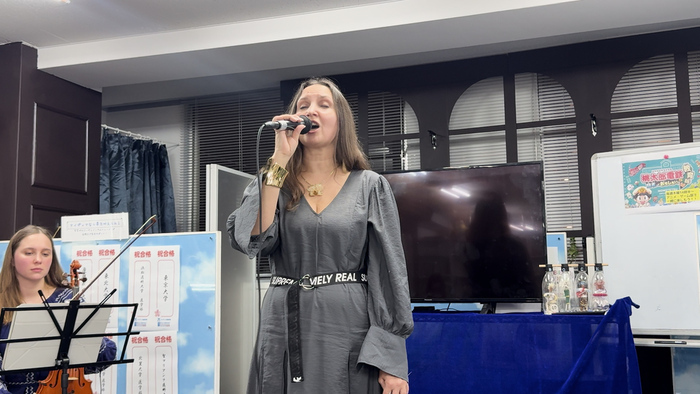
(Photo : Mariana Savka performing in song at the event)
“She tells him: breathe out,
you’re with me.
And he begins to.
He notices how fragile she has become.
And slowly the space pierced by war begins to contract.
And the migrating soul will no longer fly out of it.
Migrating soul…
Migrating soul…
Migrating soul…”
"Before The War, Life Was Filled with Ordinary Human Passions": Pavlo Matiusha and Paris. Spleen
Pavlo Matiusha read war-themed poetry alongside several poems from his pre-war collection Paris. Spleen. He also read the combat poetry by Dmytro Lazutkin, another contemporary Ukrainian poet who had been invited to the festival but was unable to attend due to ongoing military service.
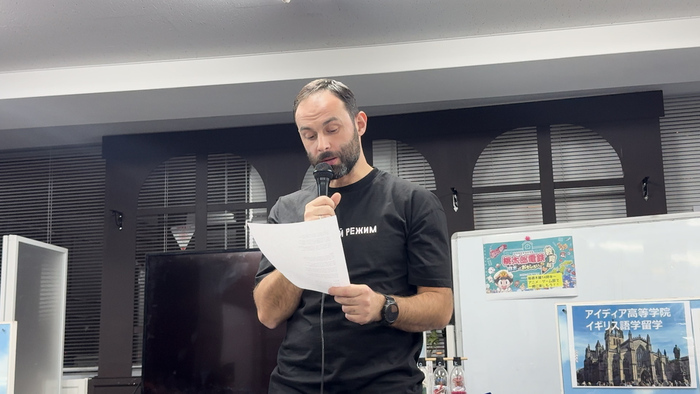
(Photo : Pavlo Matiusha reading poetry at the event)
“I dreamed of you so much,
of those burning summers of ’22 and ’23,
I longed to be with your teashing,
your wings, your thighs, your collarbones…
And then we finally met…
And I remembered a familiar graduate of a Baptist seminary
who traded her piety for the colors of life,
the way one trades clear-ringing coins for cheap bills.
I remembered my poems about you,
and your breath resting on my chest.
I cannot forget Yulia and Elia,
killed beneath the rubble after a heavy strike on the brigade headquarters.
We were not even close,
yet these women now come to me in dreams.
In truth, I want it to be you who appears in my dreams.
I want your breath on my chest.
Your distant breath,
from thousands of kilometers away.
Warm and damp,
the way it is with flushed girls.
The way it no longer happens for us…
No longer happens for us…
Poems are written
on shattered hearts.”
By Pavlo Matiusha
Matiusha brought several copies of Paris. Spleen to the festival. Published in 2019, the book reflects the author’s French period and a life shaped by pre-war experience.
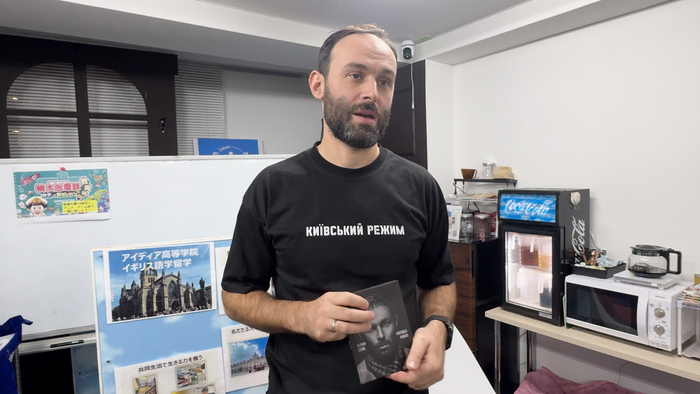
(Photo : Pavlo Matiusha with his book Paris.Spleen)
Speaking about the collection, Pavlo explained:
“Paris. Spleen echoes the title of Baudelaire’s book of prose poems, Paris Spleen. He is one of my favorite French poets. The poems carry a strong emotional weight and speak of love for a woman. Today they remind me of a distant, carefree past — a time filled with ordinary human passions, disappointments, and desires. Back then, they made up an entire universe for us - our whole life.”
As Pavlo later noted, life would soon reveal a far more dramatic and frightening reality. At the beginning of the full-scale invasion in February 2022, he volunteered to join the Armed Forces of Ukraine and served until August 2023.
His next book, the poet says, will explore the experience of survivor’s guilt.
“Fear does not exist — it is an illusion,
a transparent armor made of tears
of those who stayed far behind our backs.
Fear is when trembling rolls in,
born from the boundless courage of others,
and you are afraid you are not capable of the same:
to move forward, to fly upward,
to face demons on the high ground.
Fear is when you fear for another
more than for yourself,
because you are nimble — as your grandmother used to say,
you can stand up for yourself.
Fear is when jokes grow darker and darker,
and the image of death grows funnier and funnier.
Fear is when you see people’s carelessness
and can do nothing about it.
When you scream with all your strength,
and they do not hear you.
When your best ones leave
and do not return…
Leave and do not return…
Leave and do not return…
And you remain here — among these buildings,
among these steppes…
Guilty of everything,
like a flawed creation of the Almighty Demiurge.
You find yourself by a swift current,
neither deep nor shallow,
and you see a rainbow
speaking to the living.”
By Pavlo Matiusha
Literature as a Mission: Poets' Thoughts on Important Messages Nowadays
When asked about the importance of speaking about the war in Ukrainian voices, Pavlo explained:
“This is extremely important. For example, we know about the Trojan War not from the Trojans themselves, but from the Greeks. We do not know about the Vietnam War from the Vietnamese — we know it from the American perspective. And the world must learn about the Russian–Ukrainian war through our voices.
The world recognizes and respects strength. So we must be strong. Strong in our remembrance of those who are gone. Strong in our orientation toward the future. We must send our message forward — only in this way will we continue to exist. Because buildings, cars, roads — they have no direction, no purpose on their own. We give them meaning.
This is why we came here: to share our Ukrainian vision of ourselves, of Ukrainians, and of Ukrainians in the world. We do not seek expansion — neither cultural nor intellectual. We simply want our way of thinking, our worldview, our sense of aesthetics — the Ukrainian way — to spread across the world.”
Mariana echoed this sentiment:
“This is our mission and our purpose: to show the world that Ukrainians are not a nation that can simply be erased from the geopolitical map as some kind of error. Ukraine is a country with its own agency and voice, and Ukrainian culture is complete and self-sufficient. Each of us is an individual, a charismatic person.”
“We endure because we have immense inner strength.”
“A Moment to Feel Our Identity”: Mariana and Her Son on the Cultural Impact of the War
What emotions has the war awakened in the younger generation of Ukrainians?
Mariana’s 12-year-old son also attended the festival and shared his reflections at the end of the evening. When asked how he sees the future of the country, he answered simply yet confidently:
“I see culture flourishing, and people — most people — knowing and speaking the Ukrainian language.”
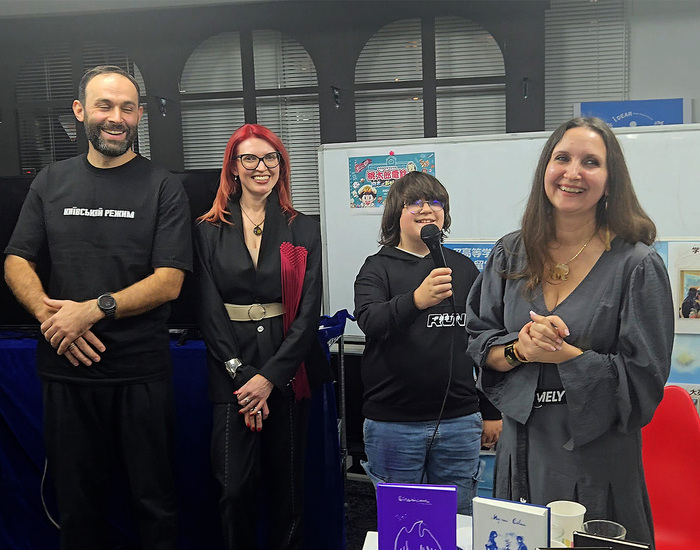
(Photo : Mariana Savka's son Severyn at the event)
For many Ukrainians, this shift carries deep cultural meaning. Due to past historical circumstances, a significant number of people grew up speaking Russian as their first language. Since the beginning of the full-scale invasion, however, many have begun to distance themselves from the shared cultural and linguistic space with Russia.
Mariana Savka emphasized the importance of this moment:
“This is extremely important. Ukraine is now at a point where people need to truly feel their identity. We are doing everything we can for this — organizing festivals, publishing books, opening new bookstores.”
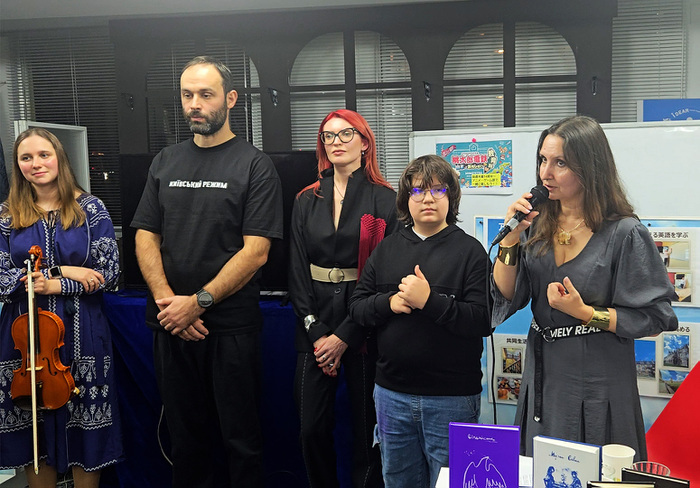
(Photo : Mariana Savka giving a speech after the event)
She added that after the country began to recover from the initial shock of 2022, a broader realization emerged:
“In 2023, many people started to understand how important it is to live now — here, in this very moment — and to do everything we can within it.”
This sense of identity, Savka noted, is inseparable from the people who sustain it. When asked what motivates her during the war, she pointed not to abstract ideas, but to those around her.
“What motivates me the most are people — people who do not give up. People who are close to you, whom you love, who are on the same wavelength, and with whom you can create extraordinary projects.”
In such moments, she added, the feeling of shared purpose becomes a source of strength.
“I feel that I am not alone, and that is deeply inspiring. I could be a lone samurai, but I am grateful that I am not alone — that there are so many young Ukrainians who feel their identity and understand that this country is truly theirs.”
“When we stand together, we are like thin sticks: individually, they can be broken, but when bound together, they cannot be broken at all.”
Beyond the Event: What Literature Brings to Light
War changes not only everyday life, but also the way people see the world. Values shift dramatically: what once seemed essential may suddenly lose its meaning. Yet one thing remains unchanged — human emotions.
The importance of festivals like this one may not be immediately obvious, but its purpose is simple. While the news delivers facts, often stripped of context and emotion, literature gives voice to lived experience, revealing the human reality behind the headlines.
For Tetiana Vlasova, this human connection was at the heart of the evening.
“It means a great deal to me that everyone who attended became ambassadors of Ukraine — here in Japan and beyond. They listened, absorbed the meaning, and carried it forward. This means that Ukraine is not silent. We are open to the world, and the world is now open to us.”
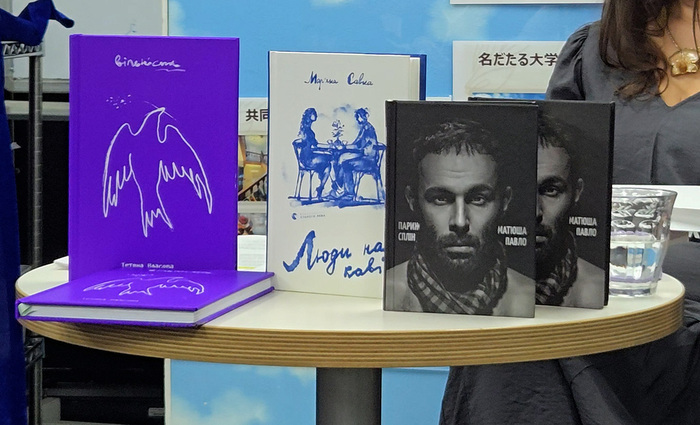
(Photo : Freedom by Tetiana Vlasova, People over Coffee by Mariana Savka, Paris. Spleen by Pavlo Matiusha)
Written by Viktoriia Melnyk