How to survive an earthquake: Essential safety tips from Japan
A powerful earthquake in Kumamoto Prefecture has been followed by hundreds of aftershocks.
How should we react and prepare? Here explains essential earthquake safety tips and highlights ;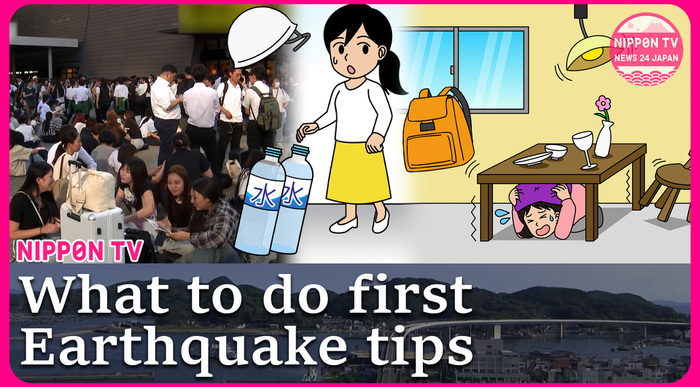
A powerful earthquake struck Kumamoto Prefecture on July 28. By the morning of July 31, nearly 300 aftershocks and other earthquakes measuring at least seismic intensity 1 had been recorded.
In a country like Japan, where earthquakes are common, what should you do if you're caught in one?
Your mobile phone may sound an Early Warning before the shaking begins. If it does, stay calm and act quickly.
If there is no designated shelter nearby, protect your head and body by taking cover under a sturdy desk or table.
Stay away from anything that could topple over, and if a helmet is available—such as one provided at a school—put it on.
After a major earthquake, aftershocks are almost certain to occur. Do not go near rivers or the coast, as there is a risk of tsunamis and other dangers.
As soon as it is safe to leave the building, evacuate to a safe location without delay.
Mobile phone networks may become unavailable after a disaster. In that case, you can use disaster message board services provided by major telecom companies to check on the safety of your family and loved ones.
Companies also provide useful information to help people in disaster-affected areas.
One example is LINE Yahoo's "Disaster Map." It displays the locations of evacuation shelters and emergency water stations announced by local governments.
The company says it also verifies information posted on social media before adding it to the map.
Major automakers are also helping people travel through disaster-hit areas.
Toyota's "Passable Roads Map" and Honda's "Road Traffic Information Map" use collected driving data to show which highways and local roads are open and which remain impassable.
Both services were launched after the 2011 Great East Japan Earthquake.
They were also used during the Kumamoto earthquake ten years ago and the Noto Peninsula earthquake two years ago.
These resources can be extremely helpful for people in disaster-affected areas.
With parts of the Kyushu Expressway still closed, many drivers are having to take unfamiliar routes.
However, cracks have also been found on local roads in many areas, so extra caution is needed.
There are also many ways to prepare before a disaster strikes.
Take some time to learn about them—they could make a real difference in an emergency.
https://int.sentia-sendai.jp/e/download/information/bousai_e.pdf
https://news.ntv.co.jp/feature/%E3%81%BC%E3%81%86%E3%81%95%E3%81%84%E5%9B%B3%E9%91%91